Over the past two weeks, I’ve returned to studying Human Design, and particularly learning about circuitry and the 36 channels. Given that my initial aim was to use these insights as inspiration for songwriting, I looked at the designs of some of the people close to me to see if I can map the information on them, or my experience with and knowledge about them, anyway.
It turned out to be quite a ride of being alternately moved, fascinated and awed. I might post the results of my first attempt at putting some of it to music at the end of this post, but first I’d like to share something that occurred to me, which is that among other things Human Design can be a tool for mapping out, with some degree of precision, the beautiful possibility of what each person could become if they lived according to their nature.
I thought of that specifically in the context of what I’d heard Victor Frankl say in one of his lectures about the importance of “taking man not as he is (…) but as he should be”. Listen for yourself:
Frankl’s position, echoing Goethe, is that aiding a man in becoming what he in principle is capable of becoming, requires recognizing a spark of the search for meaning in him, presupposing that it’s there, and consequently seeing him not as he is now, but as who he could be – the potential that is there for him to realize. It feels to me almost like by seeing the person this way, you create and hold the space which they can then grow into.
Now, given that Human Design offers every person a detailed map of who they were made to be, if you will, the question I am left with is whether knowing someone’s particular design can be helpful in recognizing his potential down to the specifics, even beyond fundamental will to meaning which Frankl refers to in the video (albeit it does seem rather fundamental).
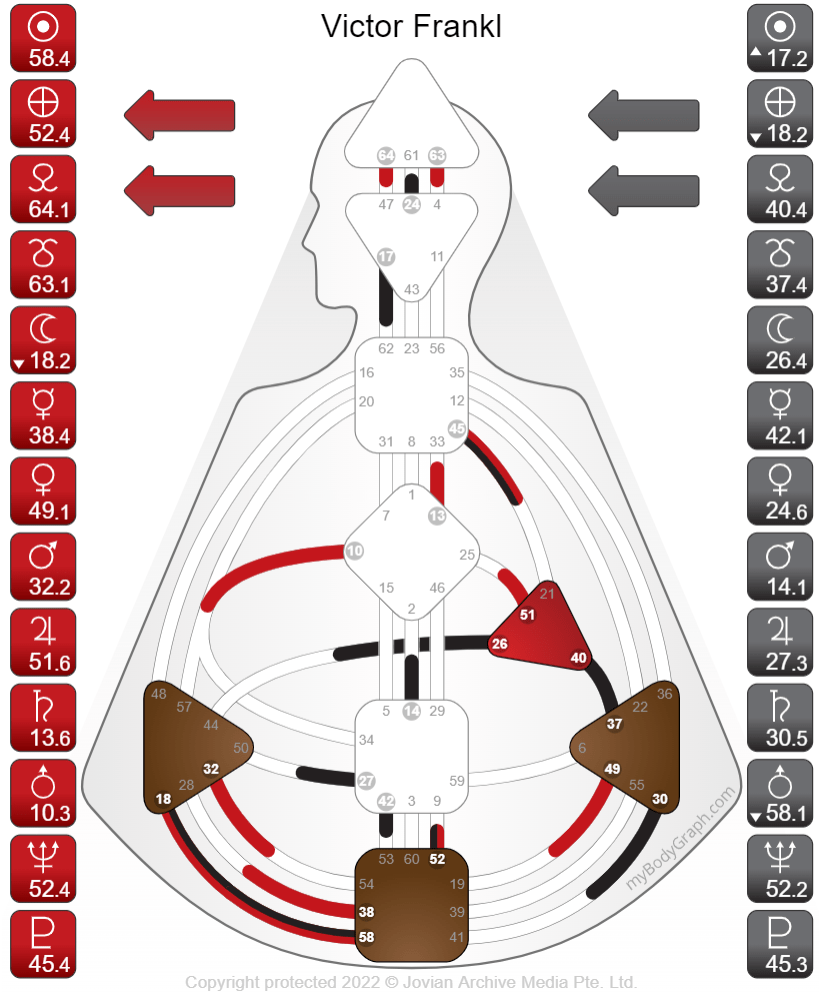
On the one hand, I recall the undying words of Ra Uru Hu about how following one’s Strategy and Authority is absolutely crucial and necessary for any of the Human Design knowledge to be any useful. About the danger in the process of deconditioning of working in the knowledge and not in oneself. I get that. And so, the whole idea behind this post may be the mind’s way of overcomplicating things.
On the other hand, the things I saw through the lens of Human Design about myself and some of the people in my life were certainly precious and inspiring – and I don’t think those feelings can lie.
To the extent that Human Design knowledge gave me glimpses of what may be possible for myself and others, to the extent it made me look where I’d never thought of looking before, I say hey, it’s worth something.
We seem to be living in a time when inspiration is hard to come by, and so I’ll take every consistent source of it I can find. It might just happen to make me see people and things as they could be more of the time, as opposed to as they are, or, in the words of Werner Erhard, as they wound up being. We shall see.
In the meantime, I’d love to hear your thoughts on this (especially you, Human Design folks). Have you experienced what Frankl was talking about in your own life? In other people’s lives? Has Human Design been a part of that, and if so, how?
Oh, and here’s my first attempt at a Human Design inspired song. Enjoy.
 Miko's Musings